Why Protein Is Vital for Body Re-Composition Goals
Why Protein Is Vital for Body Re-Composition Goals
If you've been eating "clean," moving your body, and still don't recognize what's happening to your shape, you're not imagining it and you're not doing it wrong. Somewhere in your late 30s, 40s, or 50s, the rules quietly changed. The approach that worked in your 20s — eat less, move more — stops delivering the same result, and a lot of women land here confused and a little defeated.
Here's the piece that's usually missing: protein. Not as a trend, not as a bro-science obsession, but as the single most important lever for what's actually called body re-composition — losing fat while keeping or building muscle, so the number on the scale and the way your clothes fit finally start telling the same story.
What body re-composition actually means
Body re-composition isn't the same goal as "losing weight." Weight loss just wants the scale to go down — and it doesn't care whether what you lose is fat or muscle. Re-composition is more specific: you're trying to shift the ratio between fat and muscle in your body, even if your weight barely moves.
This is why the scale can stay put while your jeans fit differently, or why two women who weigh the same can look and feel completely different. Muscle is denser and more metabolically active than fat — it's the tissue that shapes your body, protects your joints, and burns energy even at rest. Re-composition is the goal when what you actually want isn't "smaller," it's stronger, firmer, and more capable.
Why muscle loss speeds up after 35 — and why dieting alone makes it worse
Starting in your 30s, most people lose a small percentage of muscle mass per decade if they aren't actively working to keep it. That decline speeds up through perimenopause and menopause, as shifting estrogen levels change how efficiently your body builds and holds onto muscle. Research on post-menopausal women has found this can also blunt how well your body responds to protein and training compared to when you were younger — meaning it takes more deliberate effort to get the same result.
Layer traditional dieting on top of that, and it gets worse before it gets better. When you cut calories without enough protein, your body doesn't just burn fat for fuel — it breaks down muscle tissue too. That's a huge part of why the yo-yo dieting cycle is so demoralizing: you lose weight, some of it is muscle, your metabolism drops because you have less muscle to support it, and the weight creeps back as fat once you eat normally again. Repeat that cycle a few times over the years and it's no wonder your body feels like it's working against you.
Protein is the thing that interrupts this pattern. It's the raw material your body uses to build and repair muscle, and getting enough of it — especially alongside strength training — is what protects the muscle you have while you lose fat, instead of losing a bit of both.
So how much protein do you actually need?
This is the question we get asked constantly, and the honest answer is: probably more than you think.
The government's standard recommendation (the RDA) is 0.8 grams of protein per kilogram of body weight per day. That number was set as the minimum to prevent deficiency — it was never designed to support muscle building, active bodies, or women in midlife, and research increasingly shows it falls short for exactly this group.
For general health and muscle maintenance in perimenopause and menopause: expert groups researching aging and muscle health recommend 1.0–1.2 grams per kilogram of body weight per day as a baseline — noticeably higher than the standard RDA.
For active body re-composition — meaning you're strength training and specifically trying to build or preserve muscle while losing fat — most research on active adults points toward 1.6–2.2 grams per kilogram of body weight per day (roughly 0.7–1 gram per pound). That's a wide range, and where you land in it depends on how much you're training and how aggressive your fat-loss goal is.
To put that in real numbers: a 160-pound (about 73kg) woman aiming for re-composition is likely looking at somewhere between 115 and 160 grams of protein a day — a meaningful jump from the roughly 60g the RDA would suggest.
If you're a runner or endurance athlete, your needs sit a little differently. Endurance training breaks down protein for fuel in addition to the repair demands of strength work, so research on runners recommends 1.4–1.7 grams per kilogram per day during training blocks, plus a recovery dose of 20–25g of protein within 30–45 minutes after a hard effort to kick-start muscle repair and glycogen restocking.
It's not just how much — it's how you spread it out
Getting your total gram target right matters, but so does how you distribute it through the day. Your body can only use so much protein at once to build muscle — extra beyond that point is used for energy or stored, not building.
Research on midlife and older adults suggests we need roughly double the protein per meal that a 20-something needs to trigger the same muscle-building response — somewhere in the 30–40 gram range per meal, at least twice a day. This is a big reason why a piece of toast for breakfast and a salad with a sprinkle of chicken for lunch quietly sabotages a lot of well-intentioned women: the totals might look reasonable on paper, but each individual meal is too small to do the job.
A useful target to build meals around:
Breakfast: 25–35g (think: 3–4 eggs, or a Greek yogurt bowl with a protein boost)
Lunch: 30–40g (a palm-and-a-half of chicken, fish, or tofu, plus a plant protein source)
Dinner: 30–40g
Snacks: 10–20g each to fill any gaps
What it actually looks like on a plate
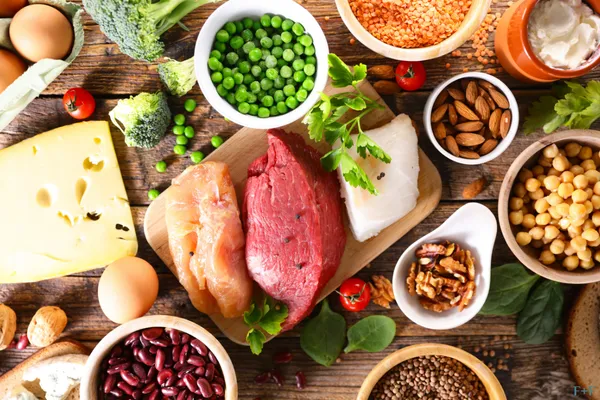
You don't need powders and scales to hit these numbers, though a protein shake can genuinely help close the gap on a busy day. Reliable everyday sources include: eggs, Greek yogurt, cottage cheese, chicken and turkey, fish and seafood, lean beef, tofu and tempeh, edamame, lentils and beans, and milk. Most whole-food protein sources land somewhere between 20–30g per typical serving, which is why building each meal around one of these — instead of treating protein as a garnish — is the fastest way to close the gap.
If you've spent years doing "everything right" and still feel like your body isn't responding the way it used to, protein is one of the most fixable pieces of the puzzle — and one of the most commonly under-prioritized. This isn't about eating less. It's about eating enough of the right thing, consistently, so your body has what it needs to hold onto the muscle you've worked for.
You don't have to figure out your exact number, meal timing, and training plan alone — and you don't have to get it perfect. Something is better than nothing, and a small, sustainable shift toward more protein starting today matters more than a perfect plan you never start.